
Eggstreme Farming Layout, flow, and species strategy
A well-placed fence earns more than a decorated house. Stack licensed pens before shelves.
Eggstreme Farming rewards farmers who think about flow — where animals live, where trays travel, and when cash moves toward the next license instead of another shelf. This page is about the decisions that compound: pen placement, species timing, and the difference between a farm that pays rent and one that slowly suffocates under it.
Read getting started before this page. If you are still buying the white-egg license, close this tab and follow the walkthrough first. This guide assumes you already have a working loop and want to scale it without borrowing from the Bank at 12 percent interest.
Pen layout: the green-sign rule
Every species pen has a green sign above it when the rental is active. Pens are strictly species-specific — a chicken yard will not accept a goose, and a duck pen will not legalize a turkey. This sounds obvious, but it traps farmers who try to “store” overflow birds in an empty-looking fence.
Chickens share the chicken yard. Browns and blues go in the same green-sign pen as whites. You do not rent a second chicken pen for color variety — you buy another license and mix trays.
Ducks, geese, and turkeys each need their own dedicated pen. Renting a duck fence to “save space” while a chicken yard is full does not work. Each species pens independently.
The practical layout rule: chicken yard first, then duck yard, then goose yard, then turkey yard — only when each license is paid off and the previous pen is printing trays that cover rent.
Tray logistics: the collection path
Eggs travel from pen to tray to vending machine. A farm where you backtrack across the yard wastes time that Tab cannot recover.
Demo-era creators who streamed long sessions learned this the hard way: a chicken yard on the far side of the map from the vending machine adds minutes to every collection run. Minutes compound. A hen that produces six eggs a day and a farm where you check trays twice costs less in labor than one where you check once and risk eggs rotting on dirt.
Place pens between the house computer and the vending machine when the layout allows. If you are building a second species yard, check its position against the machine before you sign the Management contract.
The automatic egg collector changes this calculus for busy pens. A collector in a full chicken yard (white, brown, blue) means you can focus tray runs on the vending machine instead of the pens. Buy collectors after the pen is licensed and producing — not before.
Species stacking order
The animal tier list ranks individual birds. This section ranks when to stack species, which is a different question.
Single-species baseline (hours 0–20):
One chicken pen, one license, one or two hens. White trays cover utilities. Brown unlocked when XP allows. This is the farm you bring to every other guide on this wiki. Do not rent duck space until this baseline is airtight: bins full every morning, trays vend every day, no red on the computer.
Two-species phase (hours 20–50):
Add a duck pen only when:
- Chicken trays are vending without daily attention.
- You have XP toward the duck-egg license.
- Daily duck-pen rent does not exceed what one or two duck layers add to the cash drawer.
A common mistake: renting the duck yard before buying the duck license. The Management contract says “rent,” not “unlock.” You cannot legally place ducks without the license, and you cannot sell duck eggs without the license. Rent the pen when the license is already in hand or within two days of being earned.
Three-species phase (hours 50–100):
Geese enter when ducks are paying for themselves. Geese are a later-layer species — they produce less frequently than ducks in demo-era footage but vend at a higher per-unit price. The animal tier list has exact numbers; this guide has the timing rule: geese only after duck trays cover duck rent and you are not skipping chicken bills to afford the new fence.
Four-species phase (hours 100+):
Turkey pens are the last rental. Turkeys are expensive to keep, slow to produce, and demand their own green-sign fence. The Steam community has flagged that turkey feed consumption is high relative to other species in some builds. Do not buy a turkey because the Market art looks impressive. Buy one because the profit planner says turkey trays cover turkey rent with margin left over.
Feed and water placement
Every pen has one food bin and one water container. Launch added the automatic water refill — but it fills one container at a time. If a pen has two water stations, the machine only reaches the one it is placed next to.
When placing the water refill machine, put it where it can reach the pen’s primary water container. A machine placed at the edge of a large goose yard and expecting to refill a container on the opposite side does not work by magic.
Feed does not automate in the 4 September build. The launch post teased a future automatic food refill that has not shipped. Until it does, every pen needs manual feed refills. On a multi-species farm, that means walking to each fence. A farm with four pens and a busy day job is a farm where you need the time acceleration shortcut — but only after bins are filled.
The furniture question
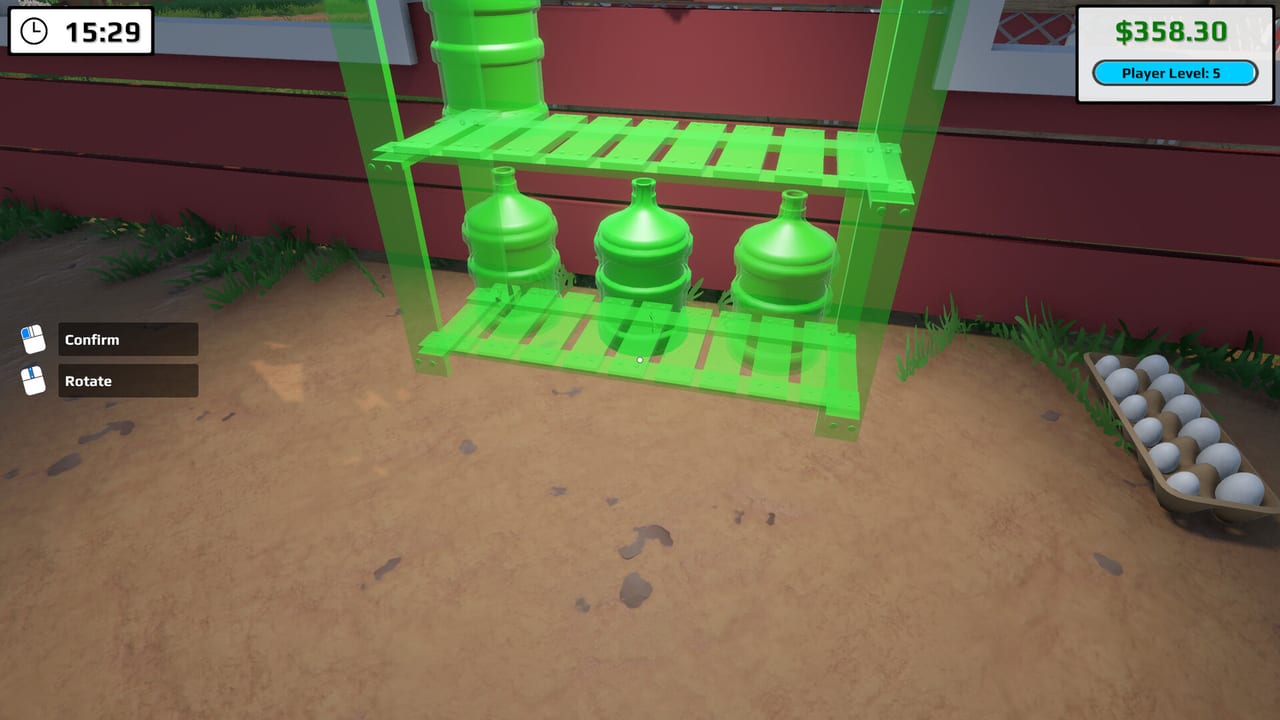
Shelves, plants, and decorative furniture appear on the Market and in the farm computer. They do not appear in any Steam achievement. They do not produce eggs.
The furniture temptation hits hardest when the farm is printing cash and the next license feels expensive. The correct move: buy the next license first. A brown-egg license adds production diversity that raises XP and opens tray combinations furniture cannot match.
Exception: shelves give trays a home so they are not scattered across the floor. One or two shelves in a pen that overflows with cartons is a logistics purchase, not a decoration. Buy it after utilities are covered and before eggs start landing on dirt.
When to sell animals instead of keeping them
Launch added the ability to remove and sell animals. This is not a profit engine — it is a pen management tool.
Sell an animal when:
- It is a duplicate that blocks a better layer from the same species.
- Its health costs exceed what it adds to the cash drawer.
- You are converting a pen’s job (chicken yard to duck yard) and the old resident has no legal place to go.
Do not sell when:
- The pen is already producing and the animal is healthy.
- You are selling because a YouTube tier list says a later species is better — tier lists rank value, not urgency.
Demo-era hen prices in clips sat in the high twenties. You will not recover a rent cycle by liquidating one bird. Sell to free a slot, then restock only when the profit planner confirms the replacement will cover daily costs.
The compound interest trap
Bank loans in demo clips sat near 12 percent interest. On a farm starting with sixty dollars, a loan that buys a second hen at twenty-eight dollars immediately creates a daily interest charge that the hen must produce more than to justify itself.
The math is simple: if a hen produces eggs worth two dollars a day and the loan costs sixty cents a day in interest, the net gain is one dollar and forty cents. That hen pays for itself in about twenty days. Fine in theory. In practice, if the hen gets sick, or a bill is overdue, or the vending machine has a full tray and you cannot sell until tomorrow, the interest still ticks.
Use the Bank when a bill is about to bounce and a partial tray cannot cover it. Do not use it to fund expansion. The bills guide covers overdue penalties; the profit planner covers the “can I afford this right now” checklist.
Daily optimization checklist
A farm that runs itself overnight is a farm that passed this checklist before Tab:
- Food bins full in every pen.
- Water containers full in every pen (or refill machine confirmed running).
- Health and immunity not in the red on any animal.
- Licensed trays collected and on the vending machine.
- Partial or six-egg tray sold if a bill is due tonight.
- No red invoices on the farm computer.
If those six items are green, Tab away. The farm that breaks is usually the one where step two was skipped because “the refill machine is on.”
Scaling without breaking
The most common scaling failure in the Steam discussions: renting a second species pen before the first pen covers its own rent. The farm bleeds daily charges against a production line that is not yet ready.
Scaling rules:
- Never rent a new pen on the same day a bill is overdue.
- Always run the profit planner before signing a Management contract.
- Wait until the existing pen’s daily trays cover its own daily rent with at least a one-day buffer before adding species two.
A farm that scales slowly compounds interest in your favor. A farm that scales fast takes on Bank debt that compounds against you.
When you are ready to automate, the automation guide covers buy order. When you are ready to rank your next animal buy against your next license, the animal tier list has the numbers.
Frequently Asked Questions
Quick answers to the most common farm questions.
Can I put ducks and chickens in the same pen?
No. Pens are species-specific with green signs. Chickens need the chicken yard, ducks need the duck pen. See the farm map.
Should I buy shelves before my second species pen?
No. Shelves are logistics, not production. Buy the next license and animal first. Buy shelves when trays overflow the floor.
When should I add a second species pen?
Only after the first pen's trays reliably cover its own daily rent. Use the profit planner before signing the Management contract.
Does the automatic water refill fill every water container in a pen?
No. It refills the container it is placed next to. Place it strategically if a pen has multiple stations.
Is a Bank loan worth it for expansion?
Only to cover an immediate overdue bill. Interest in demo clips sat near 12 percent — use loans for emergencies, not growth. See how to make money.
Should I sell animals to make money?
Only to free a pen slot or stop a health sink. Demo-era prices in the high twenties mean you will not profit by selling. Use it as management, not a revenue stream.